
Optipedia • SPIE Press books opened for your reference.
Waveguide Modes
Excerpt from Field Guide to Lasers
Waveguides have certain optical field distributions that stay constant during propagation, except for a change in the overall phase and possibly the optical power. Such field distributions, which depend on the refractive index profile, correspond to so-called waveguide modes. For a given optical frequency, a waveguide may support multiple modes, a single mode, or no mode at all.
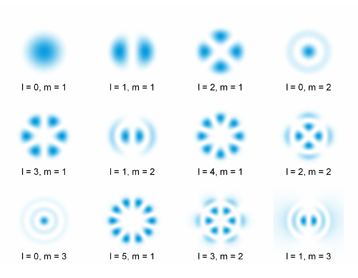
The figure shows the intensity profiles for every mode of an optical fiber (for a given design and wavelength). The lowest-order mode has a nearly Gaussian intensity profile, while the profiles of higher-order modes are more complicated. Generally, the number of waveguide modes increases with decreasing wavelength.
Each mode has a certain propagation constant ß, specifying the phase change per unit length. The lowestorder mode has the smallest ß value. If a superposition of modes is excited, the total intensity profile will vary during propagation, since (in general) the different ß values of different modes lead to varying relative optical phases.
R. Paschotta, Field Guide to Lasers, SPIE Press, Bellingham, WA (2008).
View SPIE terms of use.

